The People of Primary Care
Meet Dr. Olawale Ayeni: Family medicine rooted in empathy and humility
Welcome to our new series, The People of Primary Care: the human stories behind the healthcare you receive at your doctor’s office or healthcare hub.
For Dr. Olawale Ayeni, empathy has always been at the heart of his work.
“People are always referring family members to me and asking if I’m taking on new patients, which is the sincerest form of flattery,” he says with a smile. “To have somebody say, will you take care of my wife, daughter, or my grandchildren is the biggest compliment you can get a family physician.”
But growing up, Dr. Ayeni didn’t always know he wanted to be a doctor.
“I thought being an architect was very enticing. There is a precision to drawings things, these beautiful creations from paper to real life. Then, there was a time when I saw brilliant legal arguments and lawyers going head-to-head.”
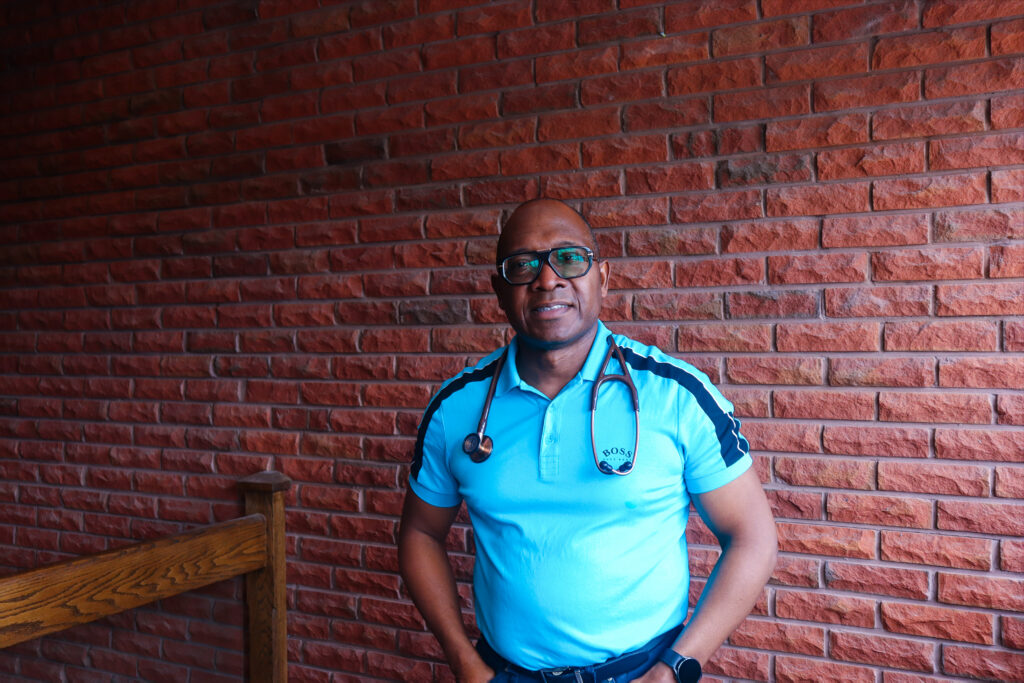
But family medicine was in his blood, as was the empathy needed for it. “My mom is a retired nurse, and she always said I would make a great doctor, not because of pride for herself, but what she saw in me,” he explains. “My father was a big supporter and encourager. As a teacher, you got an A and he would ask, did anybody get an A+? We won’t get into African or Nigerian parent stereotypes,” he jokes. “You can find those online.”
And now as a father of two, he daydreams about what his kids might grow up to do—but knows they’ll also follow their own path.
The winding road to family medicine
Dr. Ayeni describes his career as a long trajectory with many moves. After completing medical school in Nigeria in 1992, his postgraduate training began in the United Kingdom in preventive medicine in 1994, and by 1996 he had moved on to his residency training in family medicine in Detroit, Michigan.
After graduation, he worked in a small town in South Georgia for three years. “That was quite an interesting experience,” he said. “The disparities between the rich and the poor, with lots of poverty. I saw the other side of America,” he explains.
From there, Dr. Ayeni moved to Connecticut, working in a community health center “with a lot of people who were underserved and underinsured in the American system,” then to an occupational health organization, and finally he started his own private practice.
He didn’t know it yet, but Hamilton was calling him. In the early 2010s, family ties brought him to Canada. “I talked to recruiters, from Milton to Brampton, but the area that I loved the most, practice wise, was Hamilton,” he says proudly.
After speaking to five doctors who were part of a Family Health Team, he realized this was where he wanted to be. “We don’t have an in-and-out mentality of turning people away and only having one concern per visit,” he emphasizes. “No. I’ll take care of all the concerns they have.”
Since 2012, Dr. Ayeni has also worked as an attending physician at St. Peter’s Hospital (part of Hamilton Health Sciences) on the medically complex, restorative care, and behavioural health units, as well as at two long-term care facilities, taking care of elderly patients with frailty and dementia.
Navigating health and aging as both doctor and patient
“I have a lot of elderly patients. We’re all growing together, me and the patients,” he chuckles.
“I’ve also done a lot of palliative and end of life care. I am interested in helping people die with dignity.”
Beyond palliative care, he’s also a Coroner for the Hamilton Region and has helped the Province of Ontario investigate sudden and unexpected deaths, working with forensic pathologists and police. But the most important part, he explains, is how much empathy is needed in this work, especially “working with the grieving family or next of kin who just want answers for why and how their loved ones died.”
Dr. Ayeni knows intimately that every day is a gift, one that shouldn’t be taken for granted. “I’m mortal like everybody,” he says. “I share this vulnerability, because in the last five years, I’ve had some health concerns that required major surgery and a three-month leave of absence in 2025. I’m in good health now and very thankful to God for that.”
This experience has given him a unique appreciation for what patients go through as they navigate the health care system.
“We order their requisition, we send them off to see specialists, but we don’t know how they all work,” he says. “Finding unfamiliar addresses, trying to find parking, waiting and waiting. Or knowing that there is going to be a lot of pain involved in the next test or procedure.” He pauses.
“That has made me more empathetic to the plight of our patients,” he says through a smile despite the weight of the topic. “And on a personal level, I enjoy the journey of life even better. I am grateful for the ability to wake up every day.”
The impact of working with a primary care team
Dr. Ayeni explains that his 15 years in Hamilton have been the best of his career, in part because of the multicultural environment of the city, and because of the team he gets to work with every day.
“Working with dietitians, social workers, clinical pharmacists, they take a lot of load off us. I say this with a lot of humility, they know better than I do. When we work collaboratively in areas I don’t know well, I can refer and get an opinion and next steps, all for the betterment of the patient. It is all about the patient getting the best care in the right place at the right time.”
From clinic to cyclist
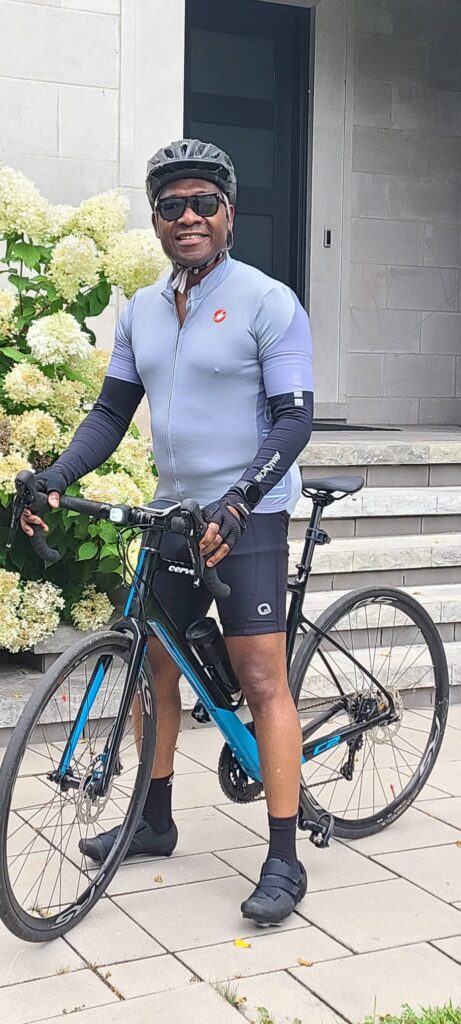
Outside the clinic, you can find Dr. Ayeni cycling. “I was more of a trail-hybrid biker, but I was always jealous of the people on the roads and wanted those speed bikes. My wife got me one for a milestone birthday,” he says proudly.
“I love when it is warm outside. May and beyond, I get in my garb, put on my helmet (very important), and I do 20 kilometers. Sometimes with friends but mostly solo rides.”
The key to longevity
Dr. Ayeni describes the importance of having a support system for your overall health and wellbeing. “My wife has been with me through the thick and thin of residency training and sleepless nights on call and many other challenges. She is my rock.”
Living a long and happy life isn’t just about exercising every day or eating good food, he explains.
“You also need community and support systems. My faith is strong and carries me through dark days. When I have medical challenges, when I have situations that concern me, I know that God will see me through.”
Dr. Ayeni emphasized what keeps him going, even when things are tough. “When I hear, ‘thank you for helping me doctor’. It is the best recognition we can get.”